Can My Origina Ido From a Former Employer Be Used Again
This guide explains actions required if you are given a fit note by an employee. It explains what different sections of the fit note mean, and how you can use it most effectively to help your organisation.
Changes to the fit note
From April 2022 you may notice changes to the fit note you receive from your employees as a new version of the form is being rolled out.
The requirement for the doctor to sign the form in ink has been removed and replaced by the issuer's name and profession being included in the form as a digital form of authorising.
There will be a period during which both the new and previous version of the fit notes are legally valid while GP systems are updated.
The fit note – the basics
5 things to do if you are given a fit note
- Check whether your employee's doctor has assessed that they are not fit for work or may be fit for work.
- Check how long your employee's fit note applies for, and whether they are expected to be fit for work when their fit note expires.
- If your employee may be fit for work, discuss their fit note with them and see if you can agree any changes to help them come back to work while it lasts.
- If your employee is not fit for work, or if they may be fit for work but you can't agree any changes, use the fit note as evidence for your sick pay procedures.
- Consider taking a copy of the fit note for your records (your employee should keep the original).
Key things to keep in mind
Supporting someone with a health condition to come back to work can save you money and minimise disruption.
People can often come back to work before they are 100% fit – in fact work can even help their recovery.
Often, a few simple changes can help someone with a health condition come back to work earlier.
Access to Work can help employees with a disability or health condition. This includes paying towards equipment or support.
If your employee is assessed as may be fit for work, their fit note will help you discuss with them what these changes might be.
The fit note won't tell you what changes to make, but will give you advice about how your employee's health affects what they can do at work.
If you can't make any changes to take account of the advice in the fit note, you don't have to.
The fit note tells you whether your employee is expected to be fit for work at the end of their fit note.
If your employee's doctor thinks they are fit for work, they will not be issued with a fit note.
Your employee can come back to work at any time, even if this is before their fit note expires. They do not need to go back to their doctor first.
The fit note belongs to your employee and they should keep the original. You may decide to take a copy for your records.
How the fit note can help you
Using the fit note to its full potential helps you reduce your sickness absence costs (for example sick pay, staff cover and lost productivity), and minimises the disruption caused by employees being off sick unnecessarily.
The fit note tells you whether your employee's doctor thinks they are not fit for any work or whether they may be fit for work (not necessarily their current job).
The advice in the fit note is about your employee's fitness for work in general, and not specifically about their current job. This gives you maximum flexibility to discuss possible changes to help them return to work (which may include changing their duties for a while).
The fit note also tells you whether your employee is likely to need a new fit note when their current one expires.
The evidence behind the fit note
The fit note is based on key principles established by a robust research base [footnote 1], and supported by healthcare professionals.
Appropriate work is usually good for people's physical and mental health.
This is also the case for people who have a health condition – work can support their recovery and help them maintain their wellbeing.
In most cases, people do not need to be 100% fit to return to work. This may not mean doing their normal job.
People with health conditions may have limits on what they can do at work, but these will not always mean they cannot do any work.
General rules of the fit note
People can only be given a fit note if their doctor considers their fitness for work is impaired. If someone is fit for work, they will not be given a fit note.
Doctors cannot issue fit notes during the first 7 calendar days of sickness absence. Employees can self-certify for this time, visit Employee's statement of sickness to claim Statutory Sick Pay for a template form. If your organisation requires medical evidence for the first 7 days of sickness absence, it is your responsibility to arrange and pay for this.
Fit notes can be handwritten, computer-generated and printed out or computer-generated and sent digitally to your employee. It must include the issuer's name and profession and the address of the medical practice.
If they are sent digitally or printed from a GP's system, it will contain a bar code. You can scan the barcode using a QR code scanner so that you can add it to your sickness records.
If a hospital doctor has issued the fit note, you may also receive a yellow Med 10 form stating the time your employee has spent as a hospital inpatient.
What to do if an employee gives you a fit note
If your employee's fit note says that they are not fit for work
You should treat this as evidence for your sick pay procedures (see more information about sick pay). You can take a copy of the fit note for your records, but your employee should keep the original as they may need it for benefits or other purposes.
Your employee's fit note will tell you how long they will not be fit for work, and whether they can expect to return to work as before once it expires. See explaining the sections of the fit note for more information.
It's a good idea to keep in touch with your employee while they are away. Guidance on managing sickness absence is available from the Health and Safety Executive (HSE).
If your employee's fit note says that they may be fit for work
You should discuss with your employee whether there are any changes which could help them return to work. These discussions can involve line managers, HR, trade unions or occupational health specialists. You can take a copy of the fit note for your records, but your employee should keep the original as they may need it for benefits or other purposes.
You do not need to be an expert in your employee's health condition to have these discussions – they should be focussed on practical ways that you could support your employee to return to work, rather than their health condition. The checklist below may be helpful in preparing for your discussions:
- look at the tick boxes and comment box for advice on what your employee can do at work, and how you can support them
- consider how long your employee's fitness for work is expected to be affected (check explaining the sections of fit note to see how you can do this).
- think of possible changes to help your employee return to work
It may be helpful to put any changes you agree down in writing, so that everyone is clear on what has been agreed. In general, any changes should last at least until the fit note expires – although this will depend on the advice in the fit note and your discussions with your employee. See some examples of employers making changes to support someone to return to work.
You may need to carry out a risk assessment to accommodate the clinical judgment in the fit note (eg if it states that your employee should avoid lifting, you are liable if you give them work that involves manual handling). Guidance on risk assessments is available on the HSE website.
If you can't agree on any changes, you should treat the fit note as if it says that your employee is not fit for work and use it as described above. Your employee does not need a new fit note from their doctor to confirm this. See an example of this situation.
Supporting your employee back to work
The tick boxes
The tick boxes enable your employee's doctor to indicate the kind of general adaptations that might help your employee return to work. This is not binding on you, and you should feel free to discuss other options:
- a phased return to work: a gradual increase in work duties or hours
- altered hours: changing their work times or total hours
- amended duties: changing their work duties
- workplace adaptations: changing aspects of the workplace
Your employee's doctor may also use the comments box to give you more detailed advice about what your employee can do at work. This advice will be about their general fitness for work, not just related to their current role, so that you have maximum flexibility to consider how you could support them to return to work. If there are particular parts of your employee's role that may be affecting their health, these will be mentioned in the comments box.
Possible changes
There is a wide range of support available to help you make changes. Check the further support section for additional help and condition-specific guidance.
Some examples of possible changes are listed below – remember that this list is not exhaustive, and the best changes are ones that are tailored to your organisation and your employee:
- changing to a different job or location
- changes to work equipment
- reduced or flexible hours
- adjustments to work premises
- a phased return to work
- giving some of their tasks to somebody else
- providing training or additional supervision
- providing a reader or interpreter
- working from home
- voice activated software
- arranging a mentor or work buddy
- working in a team instead of by themselves (or vice versa)
- arranging for an occupational health assessment
Explaining the sections of the fit note
Fit note issued without physical signature
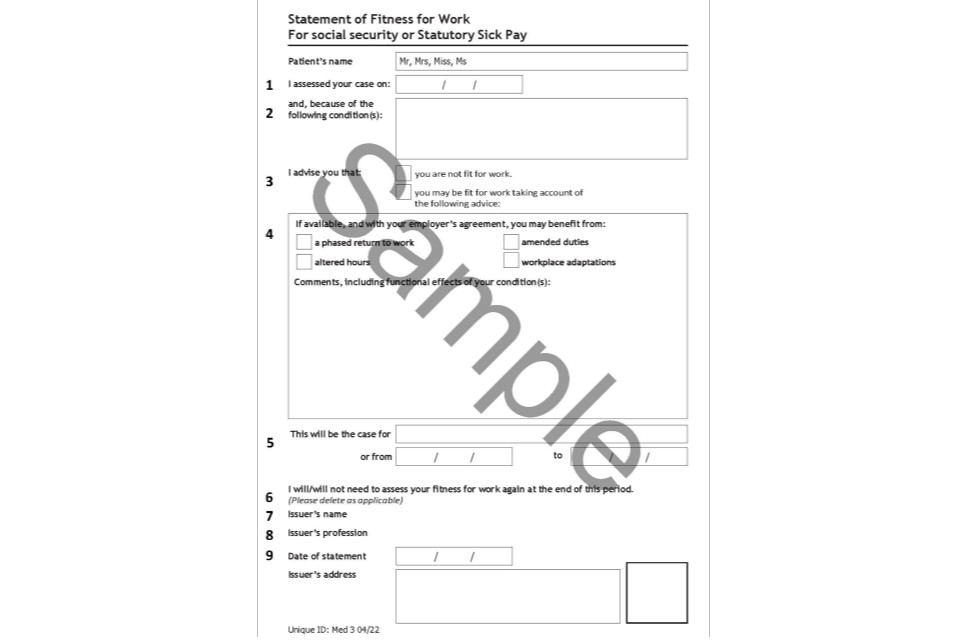
1. The date your employee was assessed by their doctor. This could be a face-to-face or telephone consultation, or consideration of a written report from another doctor or healthcare professional.
2. The condition(s) affecting your employee's fitness for work.
3. The doctor's assessment as to whether your employee is either:
- not fit for work – your employee is not fit for work of any kind
- may be fit for work taking account of the following advice – your employee may be fit for work, taking account of the doctor's advice in the fit note – this does not necessarily mean doing their normal role
4. The doctor's advice about how you can support your employee to return to work. See the tick boxes and the comments box for more information.
5. The period that the fit note covers. This will either be from the date of the assessment (Box 1), or between particular start and end dates. The dates are inclusive, (so a fit note dated from 2 April to 10 April will no longer apply from 11 April onwards).
This section may cover an earlier period if your employee's doctor judges that their condition affected their fitness for work before the assessment date.
5. The dates in this section (including any which cover an early period) can be for any period that your employee's doctor considers appropriate.
6. This box tells you whether your employee's health condition is expected to affect them after their current fit note expires:
-
I will not need to assess your fitness for work again at the end of this period – your employee's health condition is not expected to affect their fitness for work once the fit note has expired
-
I will need to assess your fitness for work again at the end of this period – means your employee's health condition may still affect their fitness for work beyond the end of the fit note (so they may need a new fit note at that point)
7. The name of the issuer.
8. The profession of the issuer.
9. The date the fit note was issued – this may not always be the same as the date of the assessment.
Fit note with physical signature
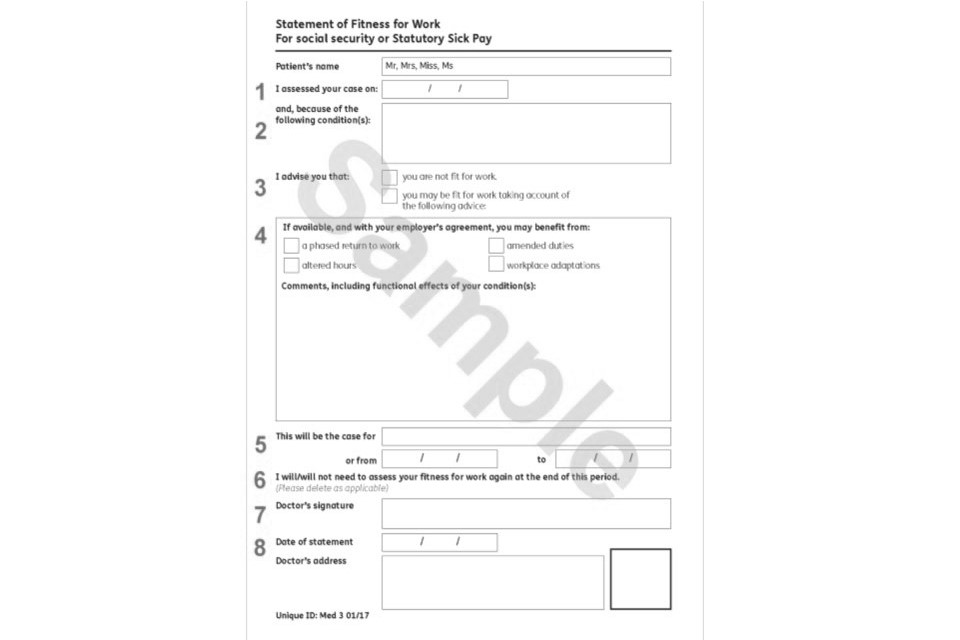
1. The date your employee was assessed by their doctor. This could be a face-to-face or telephone consultation, or consideration of a written report from another doctor or healthcare professional.
2. The condition(s) affecting your employee's fitness for work.
3. The doctor's assessment as to whether your employee is either:
- not fit for work – your employee is not fit for work of any kind
- may be fit for work taking account of the following advice – your employee may be fit for work, taking account of the doctor's advice in the fit note – this does not necessarily mean doing their normal role
4. The doctor's advice about how you can support your employee to return to work. See the tick boxes and the comments box for more information.
5. The period that the fit note covers. This will either be from the date of the assessment (Box 1), or between particular start and end dates. The dates are inclusive, (so a fit note dated from 2 April to 10 April will no longer apply from 11 April onwards).
This section may cover an earlier period if your employee's doctor judges that their condition affected their fitness for work before the assessment date.
5. The dates in this section (including any which cover an early period) can be for any period that your employee's doctor considers appropriate.
6. This box tells you whether your employee's health condition is expected to affect them after their current fit note expires:
-
I will not need to assess your fitness for work again at the end of this period – your employee's health condition is not expected to affect their fitness for work once the fit note has expired
-
I will need to assess your fitness for work again at the end of this period – means your employee's health condition may still affect their fitness for work beyond the end of the fit note (so they may need a new fit note at that point)
7. Your employee's doctor needs to sign the fit note.
8. The date the fit note was issued – this may not always be the same as the date of the assessment.
During the period the new template is being rolled out the previous one is still valid and must be signed in ink in order to be legally valid – this would also mean a copy is included so it can be recognised.
Important: Your employee can go back to work at any time (including before the end of the fit note) without going back to see their doctor, even if their doctor has indicated that they need to assess them again. This will not breach your Employers Liability Compulsory Insurance, providing a suitable risk assessment has taken place if required.
Additional questions
What does the new fit note mean for me as an employer?
From April 2022 , a fit note can be issued to your employee in a variety of ways. The only difference is the way in which the form is authorised; rather than being printed and signed the new fit note can be authorised digitally and so will include the name of the doctor who has issued it. It could be sent to the patient via SMS, e-mail, an App or other digital channels so your employee may not have a paper copy.
Your employee could be issued with the previous version of the fit note while the new template is being rolled out, which is still legally valid provided it has been signed by the doctor.
How long will I continue to receive the previous version of the fit note?
The previous fit note could be issued to your employee till all GP IT practice systems are updated. We intend to notify you and update this guidance when this is complete and the previous version should no longer be accepted.
What if the fit note is not signed or does not include the name of the doctor?
Fit notes are required to be signed or to include the name of the doctor that authorised it to be legally valid. Whether it is the previous or new version of the fit note, if it does not include the doctors signature or name then it should not be accepted as it may not be genuine.
Does my employee need a fit note saying they are fit for work?
No. People do not need to be signed back to work and there is no option on the fit note to do so. If your employee's doctor assesses that they are fit for work, they will not be issued with a fit note.
Your employee should return to work once their fit note expires (if they have not already done so) or will need a new fit note.
For a limited number of jobs, there are separate procedures to ensure someone is fit to carry out their role. Your HR, occupational health or legal department should know if this applies to your organisation.
If your organisation has a separate policy which requires someone to obtain medical evidence that they are fit for work, this should be arranged through a private arrangement with a GP or occupational health specialist. Once your employee's doctor has assessed them as fit for work, they cannot issue any further fit notes to cover a period while they are waiting for additional health checks required by your organisation.
Can other forms of medical evidence be accepted as of sickness absence?
Other forms of medical evidence including private medical certificates, Allied Healthcare Professionals Advisory Fitness for Work Report can be accepted as medical evidence in the same way as a fit note subject to your agreement. In this instance you do not need to ask your employee to obtain further fit notes from their GP.
What should I do if I do not understand the advice on the fit note?
First, see if your employee can provide any more information. If you are still unsure, you could consider advice from an occupational health specialist. You can write to the doctor for more information although you may have to pay for this service and doctors may not be able to respond immediately.
What if a fit note says my employee's job may be affecting their health?
You should consider this carefully and bear in mind your responsibilities under health and safety regulations. The law requires you to record work related injury and illness and report certain cases to the relevant enforcement authority. It is very easy and straightforward to do this – see further information on types of reportable incidents.
What if a fit note recommends that I seek occupational health advice?
It is your decision whether to act on this advice and in some cases you may be able to support your employee without needing additional expertise. For complex or possible work related conditions, support from occupational health specialists should be seriously considered.
What should I do if I offer support to an employee and they refuse?
Your first step should always be to ask your employee why they believe they cannot return to work, as there may be something you have not considered.
If you can't reach agreement, you may want to consult an occupational health specialist. If necessary you should consider your organisational policy for absence disputes, which may give you guidance about sick pay rules when suitable work is refused.
You can get more information from ACAS, and your employee may wish to seek advice from their trade union or an advice centre.
How does the fit note affect sick pay?
The fit note can be used as evidence for your sick pay procedures. If your employee's fit note states that they may be fit for work but you agree that they should remain off work, then they can still receive sick pay (because in these circumstances you treat the fit note as if it stated not fit for work).
If your employee returns to work on reduced hours, you should consider whether your employee might be financially disadvantaged. In such cases you may decide to pay sick pay for the hours not worked, or to pay full pay despite the reduced hours.
More guidance about Statutory Sick Pay.
Can I refuse to pay sick pay even if my patient has a fit note?
If there is good reason to believe that an employee's incapacity is not genuine, you can refuse to pay sick pay despite your employee having a fit note. For more information, visit Statutory Sick Pay.
Am I still covered by Employers' Liability Compulsory Insurance?
Your liability insurance does not prevent employees who may be fit for work from returning to work. You should ensure that you take account of the advice in the fit note, perform any relevant safety procedures and consider whether a risk assessment is necessary. Contact your insurer if you have any concerns.
What if a fit note is for an 'indefinite' period but I can't accommodate any of the advice?
You should consider as many ways as possible to help your employee back to work, including moving them to a different role. There may be additional legal issues to consider, for example your duties under the Equality Act.
Dismissal is a last resort and could be unfair if not handled properly, see further information on Dismissing staff. Ideally you should follow the ACAS Code of Practice on disciplinary and grievance procedures.
Is the fit note binding on me?
No. The assessment about whether your employee is not fit for work or may be fit for work (and any other advice in the fit note) is classed as advice, and it is for employers to determine whether or not to accept it.
Occasionally, you may believe that your employee is not fit for work when they have been assessed as fit for work by their doctor, or you may think that your employee could do some work when they have been assessed as 'not fit for work' by their doctor.
In situations like this you are within your rights to gather other evidence about your employee's fitness for work from other doctors or healthcare professionals. You can choose to give this other evidence precedence over the advice in the fit note. Your employee may disagree with you, and you may need to demonstrate to an employment tribunal why the alternative source of evidence was more acceptable to you than the fit note.
Further support
Supporting employees with health conditions
Access to Work provides practical and financial support to people with a physical or mental health condition or disability to help them keep a job. This can include paying towards aids or equipment; support workers; support services or travel to and in work.
The Royal College of Surgeons of England have produced a Recovering from Surgery resource with practical tips about getting back to work following some common surgical procedures.
The Royal College of Obstetricians and Gynaecologists' website gives advice on returning to work after gynaecological procedures.
The Royal College of Psychiatrists provide advice about returning to work after a period of mental ill health, with specific sections for workers, employers and clinicians.
Macmillan provides information about work and cancer for patients, carers and employers.
Occupational health services
Occupational health support can be very helpful in complex cases and when work may be affecting your health. You may have in-house occupational health services which are often provided by large employers and sometimes by the NHS or local authorities. Trade or regional business associations may have details of occupational health providers or other sources of help. For details of providers in your area, contact:
Commercial Occupational Health Provider Association
NHS Health at Work
Society of Occupational Medicine
Safe Effective Quality Occupational Health Service (list of approved occupational health providers).
Managing sickness absence, disputes and sick pay
Statutory Sick Pay (SSP): employer guide
The Health and Safety Executive has provided guidance for employers and managers on managing sick leave and return to work.
British Occupational Health Research Foundation has also developed guidance for managing rehabilitation and return to work following sickness absence.
For questions about Statutory Sick Pay, visit Statutory Sick Pay (SSP).
The Employer's Charter helps employers understand what they can do in respect of a number of issues.
For help on avoiding or managing work related disputes, visit ACAS or contact them on 0300 1231100.
Illustrative examples of the fit note in action
Case study 1: An employer makes changes – working from home
You run a publishing firm with 10 employees. One of your proof readers gives you a fit note saying that he has a common cold and cystic fibrosis, but that he may be fit for work taking account of the following advice, and the workplace adaptations box is ticked. His fit note has a duration of 10 days and his doctor has indicated that they do not need to see him again once it expires.
The advice in the comments box reads: Your employee cannot travel into the office because he is at high risk of developing a chest infection whilst he has a cold. The increased risk is due to his pre-existing chest condition: cystic fibrosis. He is able work from home during this period.
You jointly discuss his fit note and agree that he should work from home for the next 10 days – you email him some work to do, and he does not go on to sick leave. After 10 days, your employee has recovered from his cold and goes back to work in his previous duties without going back to see his GP.
Case study 2: An employer makes changes – a delivery driver who can't drive
You manage 3 people in a delivery company. One of them is a driver who has just had laser eye surgery and cannot drive for 2 weeks. Because the fit note is about someone's general fitness for work, your driver's doctor assesses that he may be fit for work taking into account the following advice and ticks the amended duties box.
The advice in the comments box reads 'Dry eyes, may experience temporary blurring of vision. Should not drive for 2 weeks. Can still perform other reasonable physical tasks. Mental function unaffected. If he uses a VDU he should take regular short breaks as per standard guidance.'
The fit note states that the doctor will not need to assess him again once it expires, so you plan for him to be back to work as normal at this time.
You discuss the fit note with your driver and agree that although he should not drive, his knowledge of the company and its operations means you decide to use him in a back office role for the 2 weeks. After 2 weeks his eyesight is back to normal and he goes back to his driving job, without going back to see his doctor.
Case study 3: An employer makes changes - phased return to work
You are the manager of a local supermarket. One of your checkout assistants sends you a fit note saying she has anxiety disorder. The assistant's fit note states that she may be fit for work. The comments box says 'can perform physical tasks, but she gets anxious when faced with confrontations and difficult customers and should not be left alone'. Her doctor ticks 'amended duties'.
The fit note has duration of two weeks. You make arrangements for Statutory Sick Pay to be paid and decide to keep in touch with the assistant while she is away so she doesn't feel cut off. Two weeks later you receive the next fit note which states that your employee 'may be fit for work' and suggests a phased return to work starting with just a few hours a day as well as other workplace adjustments which include not having to speak to customers during busy periods.
You are happy with these recommendations and arrange for her to do quieter shifts or work away from the shop floor during busier times. You also arrange for her to attend a course which teaches coping techniques. This is intended to help her become more confident when dealing with customers.
After 4 weeks, the assistant informs you that she feels more confident when dealing with the public and says she would like to return to normal duties. You agree to this and she returns to work as normal.
Important information
This is only a guide and does not cover every circumstance. We have done our best to make sure that the information is correct as of April 2022. It is possible that some of the information is oversimplified, or may become inaccurate over time, for example because of changes in the law.
Source: https://www.gov.uk/government/publications/fit-note-guidance-for-employers-and-line-managers/getting-the-most-out-of-the-fit-note-guidance-for-employers-and-line-managers
0 Response to "Can My Origina Ido From a Former Employer Be Used Again"
Post a Comment